.avif)
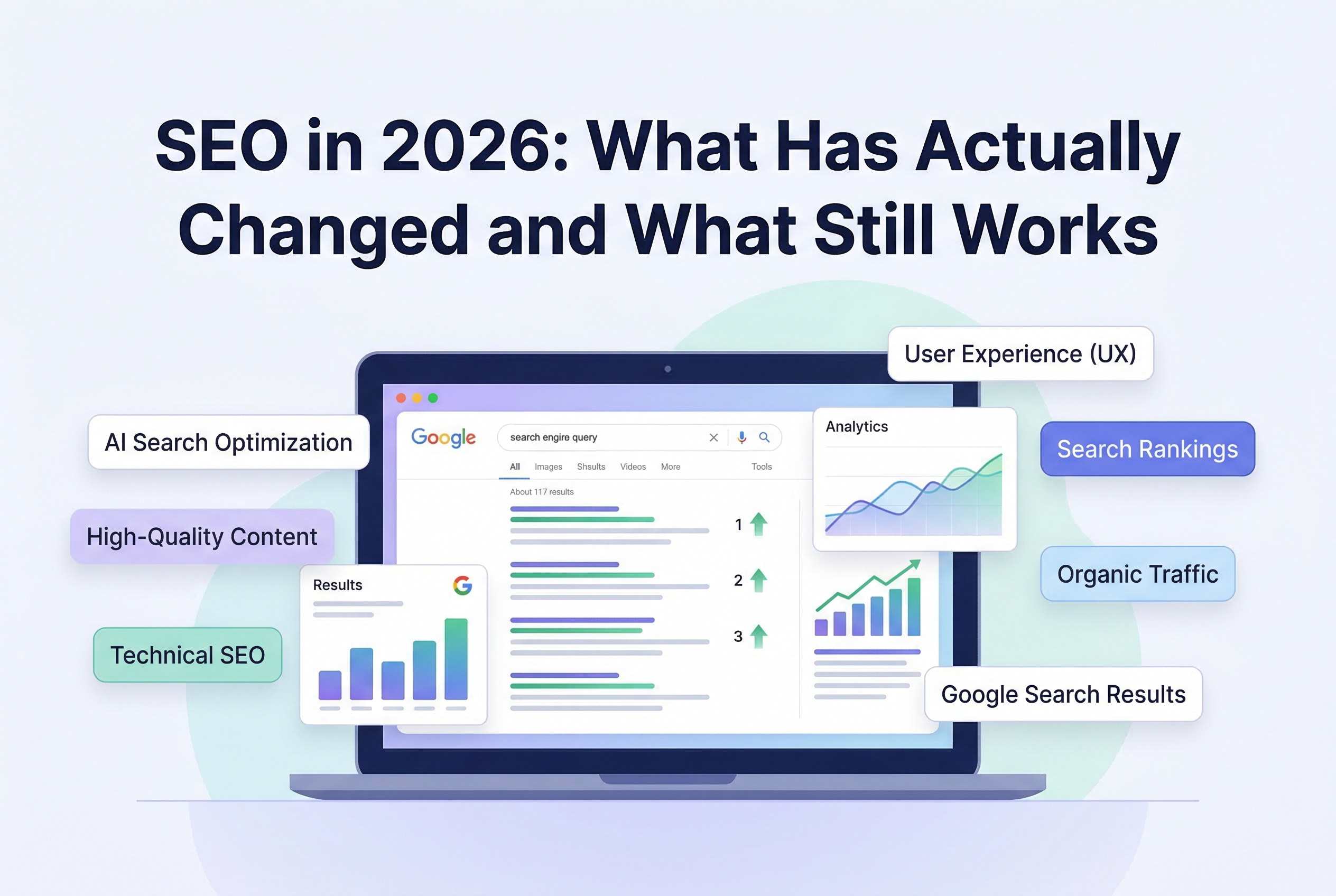
SEO in 2026: What Has Actually Changed and What Still Works
What Has Fundamentally Shifted
The biggest change in SEO right now is not a technical update. It is a shift in what Google considers a trustworthy result. For years, SEO was largely a game of signals — backlinks, keyword density, page speed scores, schema markup. Those things still matter. But the weight of the game has moved toward something harder to fake: genuine expertise and real user satisfaction.
Google's AI Overviews — the summaries that now appear above organic results for many queries — have changed what it means to rank. For informational searches, a featured position in an AI Overview can deliver visibility without a click. For transactional and local searches, the traditional blue links remain critical. Understanding which type of search your business depends on is more important now than it has ever been. The businesses winning in 2026 are not gaming the algorithm. They are building content and experiences that genuinely serve the person searching. The algorithm has gotten good enough to tell the difference.
What Google Is Actually Rewarding Right Now
Experience, expertise, authoritativeness, and trustworthiness — the framework Google has used to evaluate content quality for years — now operates with more nuance than before. It is no longer enough to tick those boxes structurally. The content itself has to demonstrate them. What this looks like in practice: articles written by people who clearly understand the subject from real experience, not from scraping other sources. Pages that answer the specific question being asked without padding the word count. Websites that load quickly, display properly on mobile, and do not frustrate users with intrusive pop-ups or confusing navigation.
The technical side of SEO has not gone away. Core Web Vitals, indexability, internal linking structure — these are still the foundation. But they are the floor, not the ceiling. Meeting technical requirements gets you considered. The content and the user experience determine whether you rank. Local SEO has also become more competitive and more nuanced. For businesses serving a specific geographic area, Google Business Profile optimisation, local reviews, and locally relevant content carry significant weight. A local business that invests in these areas consistently outperforms one with a technically superior website that ignores local signals.
What No Longer Works the Way It Used To
Thin content built around keyword volume does not perform. A 500-word article that covers a topic superficially, written primarily to target a search phrase, will not rank against a piece that genuinely addresses the reader's question in depth. Exact-match keyword obsession is also counterproductive. Google understands semantic relationships well enough that forcing a specific phrase into every heading does more harm than good. Natural language, covering the topic thoroughly, works better.
Backlink schemes — paid links, link exchanges, network-built profiles — remain against Google's guidelines and are more detectable than ever. Legitimate backlinks, earned through genuinely useful content, still carry real authority value. The difference is entirely in how they are acquired.
What Still Works and Always Will
Pages that clearly answer a specific question in full, without requiring the visitor to go elsewhere, rank well. They always have. The format changes — featured snippets, AI Overviews, structured data — but the underlying principle does not. Websites that load fast and work properly on mobile retain visitors. Retention signals matter for rankings. A page that drives people away immediately, regardless of content quality, will not sustain a strong position.
Building topical authority — covering a subject area in depth across multiple pieces of content rather than writing one post and moving on — still provides a significant competitive advantage. Google rewards websites that demonstrate sustained expertise on a topic over time.
The Practical SEO Priorities for 2026
For most small and mid-sized businesses, the highest-impact SEO activities right now are not exotic. They are consistent execution of fundamentals that many competitors are still ignoring. Audit your existing content. Identify pages that rank on page two or three for relevant terms and improve them — more depth, better structure, more directly useful to the reader. Improving existing content is faster and often more effective than creating new content from scratch.
Optimise for search intent, not just keywords. The question is not what phrase do people type, but what are they actually trying to accomplish. A page built around the intent behind a search will outperform one built around the literal phrase. Take local signals seriously. If your business serves a specific area, your Google Business Profile, local citations, and location-relevant content are among your most valuable SEO assets. Build content that demonstrates real expertise — write in a way that shows genuine understanding of the subject, the nuances, the common mistakes, the things that are not obvious.
Benefits of a Strong SEO Strategy in 2026
Sustainable Traffic Without Ongoing Ad Spend
Paid advertising stops the moment you stop paying. Organic search traffic, built on a solid SEO foundation, continues to generate enquiries over time. For businesses with limited marketing budgets, the long-term return on SEO investment is substantially higher than most paid channels.
Visibility When It Matters Most
Appearing in search results at the moment someone is actively looking for what you offer is the most direct form of marketing available. Unlike social media or display advertising, search is intent-driven — the person is already looking. SEO puts your business in front of that audience at exactly the right moment.
Credibility by Association
Ranking consistently for relevant searches builds brand credibility over time. People associate strong search presence with authority and trustworthiness. It is not just about the traffic — it is about the perception that sustained visibility creates.
Compounding Returns Over Time
SEO compounds in a way that most marketing channels do not. Content that ranks well continues to attract traffic. Each piece of content that performs well supports the authority of the overall site. The businesses that have invested consistently in SEO for two or three years are now benefiting from compounding returns that are very difficult for late starters to replicate quickly.
Frequently Asked Questions
How long does SEO take to show results in 2026?
The honest answer is three to six months for meaningful movement on competitive terms, though less competitive local and niche searches can show results faster. SEO is not a quick-return channel. The businesses that benefit most treat it as an ongoing investment rather than a one-time project. The quality threshold for results has risen, which means shortcuts that appeared to work short-term now rarely do.
Does social media activity affect SEO rankings?
Not directly. Google does not use social media signals as a ranking factor. However, strong social media presence can drive traffic to your website, increase the chance of earning backlinks from people who discover your content, and build brand awareness that leads to more branded searches — all of which have indirect positive effects.
Is blogging still worth doing for SEO?
Yes, when done with intent. A blog that consistently publishes well-researched, genuinely useful content builds topical authority and attracts organic traffic over time. A blog that publishes generic, low-effort posts for the sake of appearing active provides minimal value. Volume matters less than quality and relevance to what your target audience is actually searching for.
How important is technical SEO compared to content?
Both matter, but the relationship is sequential rather than competitive. Technical SEO — site speed, crawlability, mobile performance, structured data — is the foundation. Without it, even excellent content may not rank. With it, content quality and relevance become the primary differentiators. For most small business websites, basic technical health should be addressed first. After that, the ongoing effort shifts to content and authority building.
.avif)

© Copyright WebRedo 2026. All Rights Reserved
.avif)